The case for hiring exhibition stands
It doesn’t matter what you hire, from a wedding venue to a floorboard sander to a private jet – there’s always a simple financial reason behind it, compared to buying. Basically, you’re temporarily “owning” something for a fraction of the price of owning it outright. The rental company benefits from being able to recoup their costs and start turning a profit, while you benefit from not having to go to all the expense and trouble of buying, maintaining and storing the item.
But there are other considerations that make hiring a stand attractive to businesses. For example, storage can be an issue for businesses with small premises, or no formal premises. The only option is to pay for secure storage space off-site, and that needs to be budgeted for. Similarly, there could be transportation and installation issues. Many stand hire companies will deliver the stand to the venue and set it up, then take it down and remove it after the event. You don’t need to learn how to set it up, or to pay for transportation.
Another benefit is that you should have immediate access to the latest trends and technologies if you choose the right hiring partner. Just like hiring a car, there’s competition among renters to provide the best equipment, so they’ll be constantly on the lookout for new innovations in the exhibition sector, which you can take advantage of.
Exhibition stands for hire also tend to be flexible by nature, which usually means a modular construction that allows multiple configurations. That’s great because whatever the footprint and height restrictions of your allocated space, there should be a setup that’ll slot right in. (That said, many businesses who buy their own stands to opt for a modular setup for that same reason – not all venues and spaces are the same, so it makes sense to have options.)
Finally, you probably don’t have to worry about general maintenance, insurance and modifications, although this will depend on the deal you have with the rental company. These can add up to sizable costs when you own your own stand.
Who benefits most from hiring their exhibition stand?
As you can see, there are benefits to hiring your exhibition stands. While it’s not for everyone, typical situations where it can be of benefit include:
- Companies with irregular exhibition schedules – do you just do one show a year, or maybe just one show in total? It’s almost certain that hiring will be more cost-effective.
- Businesses testing new markets or events – if your presence is experimental or speculative, it might not be worth splashing out on a whole system.
- Organisations with limited storage facilities – even when disassembled, a moderately-sized stand can still need several cubic metres of storage space. Do you have room?
- Companies wanting different designs for different audiences – your business might sell in different markets with their own expectations, and one style or size of stand would not be a perfect fit everywhere.
- Exhibiting abroad – transporting a stand can be expensive using air or sea logistics, so it might work out better to hire from a local firm.
The case for building or buying an exhibition stand
To justify the expense of owning an exhibition stand, it mainly comes down to money. Hiring might be cheaper than buying for a one-off expo, or even for several shows, but there comes a break-even point where it becomes cheaper to buy, store and transport your own system. Yes, there are other benefits to hiring, as mentioned above, but in terms of money invested and how well the stand fits your business’s needs, owning usually becomes the best option all round.
Outside of the direct costs of ownership, the benefits do start to stack up. The main one is that it’s completely yours. It is designed in line with your corporate aesthetic, with your branding, lighting, storage, display areas and furniture exactly how you want it. The branding ensures consistency throughout, and if you want to cover all your walls, floors and furnishings in your own company colours or messages, there’s no cheap, practical way to do this when you’re hiring. You will never get a setup that’s millimetre-perfect for your displays.
Even things like staff training fall under the bespoke benefits – you can work out the best places to stand to greet visitors, where to take them and how best to demonstrate products and have private chats with potential leads. That sort of expertise only comes from experience. The stand plugs directly into your whole marketing and sales operations – sales staff can direct clients to your stand, or even a specific part of your stand, with the confidence that they’re describing it accurately, months in advance.
You’ll be in complete control of all the design elements, so you can decide, for example, to have a stand with a small carbon footprint, or one packed with interactive elements. And you’re also in charge of quality control. Little chips and scrapes do mount up, and the quality of the materials used will also impact those all-important first impressions. When you’re hiring, you basically get what you’re given. Time margins are tight during the setup phase at a venue, so there’s no opportunity to send for replacement panels or flooring. With your own stand, you can choose to upgrade bit by bit to maximise cash flow, so you’ve constantly got a fresh setup.
Finally, there’s the availability factor. It’s yours to use as and when you like, how you like. Although there are exhibitions all year round, there are certain seasons when demand peaks. It can be quite tricky finding a stand during these times, especially at short notice. And if you do find one, it might not be to your exact specifications. When you have your own stand, you just pick it up and go.
Who benefits most from owning their exhibition stand?
With all this in mind, we’d say that you would probably benefit from buying your own stand if you fall into one or more of these categories:
- Regular exhibitors – if you’re doing more than three shows per year, it’s almost certainly worth buying a stand rather than hiring for a few years.
- Companies with established exhibition strategies – if exhibitions are part of your overarching strategy, you’re leaving less to chance when you have your own stand, so everything is more predictable.
- Businesses with adequate storage solutions – storage costs are absorbed by your regular premises costs, so there are no extra expenses.
- Organisations prioritising brand consistency – is brand consistency vital to your operation? You can only guarantee this with your own stand.
- Companies with specific technical requirements – whether it’s demonstrations, interactivity, displays, lighting or some other technical needs, it will be difficult to find a hire company that meets your exact specifications.
Weighing up the return on investment
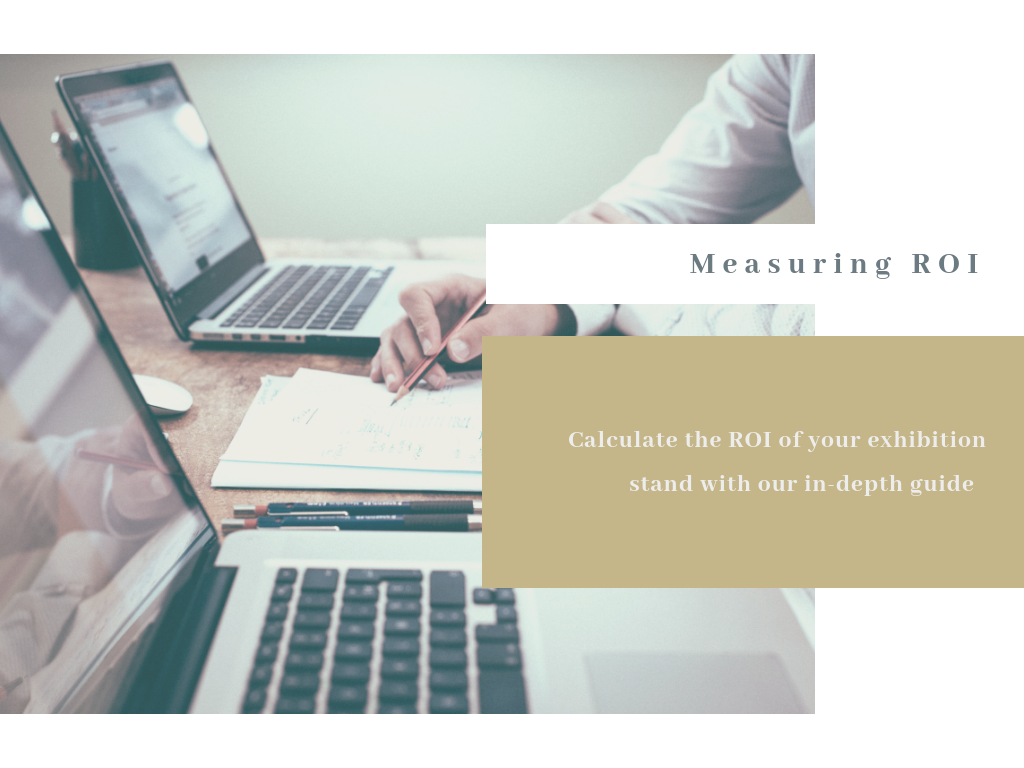
When it comes to exhibiting at conferences, shows and trade fairs, calculating return on investment can be pretty complex. We’ve written an in-depth article on how to balance the expense of exhibiting with the potential benefit, and it’s definitely worth a read.
In short, having an exhibition presence is a blend of sales, marketing and PR, and the estimated value of a given show can be worked out. That, in turn, can influence how much you think you should spend on your stand, training, transportation, hospitality and staffing. Ultimately, it all comes down to your position in your sector right now, and where you’d like to be in a few years, and whether exhibiting to very specific audiences will help with your medium-term sales strategy.
For the purposes of this article, however, we’re comparing buying a stand with hiring them on an ad hoc basis. When you’re hiring, your cost calculations will look something like:
- Typical rental costs per event;
- Additional fees (delivery, setup, modification options);
- Hidden costs that can accumulate; and
- Staffing expenses.
Building your own stand will incur its own set of costs, typically:
- Design and construction costs;
- Maintenance considerations;
- Storage expenses;
- Transportation costs;
- Staffing; and
- Resale value (which can recoup some of your initial costs).
Rental is composed entirely of expenditure for each event, whereas building your own is a mixture of initial one-off costs and repeated expenditures. As we discussed above, there’s a break-even point where repeated expenditure of hiring is equal to the one-off costs, if you ignore the shared ongoing costs like staffing. At that point, it’s usually worth buying, but only if you are actually getting a benefit from exhibiting. If it’s a net loss, it might be worth channelling your marketing and PR in other directions.
So, if your cost/benefit analysis shows that exhibiting is worth it, you need to ask ask yourself:
- How many exhibitions will we attend annually?
- What’s our three-year exhibition strategy?
- How important is brand consistency across events?
- Do we have adequate storage and logistics capabilities?
- What’s our risk tolerance for availability?
Answering these important questions should fill in the blanks and help you to decide on hiring or buying and owning a stand.
Which is right for you?
Hopefully, this article has covered all the important factors that need to be considered when making this important decision. Of course, the first consideration is whether you need to show up at exhibitions and trade fairs in the first place. Some sectors don’t really have a thriving exhibition scene, and if you’re in one of those, you will probably find that you would not be reaching the target decision-makers that you would like to.
However, for most verticals, having a strong exhibition presence proves to be a positive thing. Clients who have never heard of you can get to know your offerings, and those that are aware of you can talk business, meet key people and experience your products and services first-hand.
Also, don’t forget that your best option might not come down purely to cost. If you are at or near the break-even point when it comes to costs (which typically happens if you exhibit two or three times a year), consider the benefits that are specific to one model. For example, if you are in a dynamic industry and might not know until quite late that you are going to exhibit, it’s safer to have your own stand in storage that you can grab and go, without entering the hiring lottery. On the other hand, if you like to try out different looks and feels each time you exhibit, the hiring model might suit you better.
In summary, both options can be viable, but there are considerations that will tip the balance one way or the other, depending on how important regular exhibiting is in your sector. It’s a decision that can only be arrived at once you have assessed your overall sales strategy for the next few years. Then, the nature of your exhibiting efforts should be discussed with your sales, marketing and/or PR teams, as it’s vital that your presence at events is in line with their own plans.
If your analysis suggests it’s probably best to get your own stand, it’s time to talk to the exhibition stand experts. We can discuss options that will help you to get a phenomenal stand that meets your budget, and opens the door to a world of opportunity in the exhibition space.